



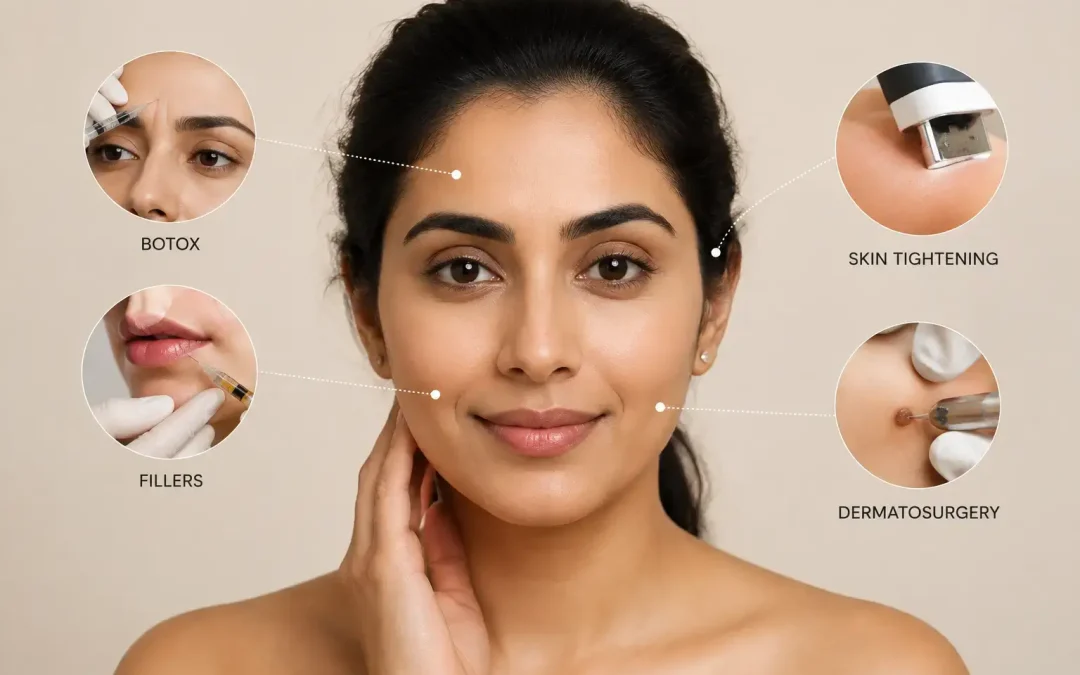
Modern aesthetic dermatology offers many options for people concerned about facial ageing, skin laxity, changing facial contours, or unwanted skin growths. The difficulty is understanding which treatment addresses which concern.
Botox, fillers and skin-tightening procedures may all be discussed within anti-ageing treatment, but each works differently. Dermatosurgery, on the other hand, deals with an entirely different group of concerns. This is why choosing an anti-ageing clinic should begin with an individual facial and skin assessment rather than selecting a treatment from a menu.
What Changes as the Face Ages?
Ageing is not caused by one change alone.
Over time, the face may experience:
- Fine lines
- Expression wrinkles
- Volume loss
- Changes in facial contours
- Skin laxity
- Reduced firmness
- Under-eye changes
- Changes in skin texture
Different treatments address different elements of this process.
What Does Botox Do?
Botox treatment is commonly considered for selected expression lines caused by repeated muscle movement. Botulinum toxin temporarily reduces activity in specific muscles. This means it works differently from fillers, which are generally used to restore or modify volume. The location and amount used should be determined according to individual facial anatomy.
What Are Fillers Used For?
Filler treatment may be considered when the concern involves volume loss, contour changes or certain facial lines.
Different areas of the face require different approaches, and not every facial concern requires filler.
Natural-looking results generally depend on carefully assessing facial proportions rather than simply adding more product.
Skin Tightening Is Different Again
Skin tightening treatment may be explored when loss of firmness or mild skin laxity is the primary concern.
Depending on the technology, controlled energy may be used to stimulate tissue remodelling.
The improvement tends to develop gradually, and results vary according to age, skin condition and degree of laxity.
Skin tightening should also not automatically be considered a substitute for surgical lifting in cases of significant sagging.
When Is Dermatosurgery Needed?
Cosmetic dermatology is only one part of skin care.
A dermatosurgery clinic may also treat concerns such as moles, warts, lipomas and torn earlobes.
These conditions require a different approach from anti-ageing procedures.
For example, a mole should first be examined before it is removed, particularly when it has recently changed in size, shape, colour or appearance.
Similarly, a lump under the skin should be properly evaluated before assuming it is a harmless lipoma.
Mole, Wart and Other Skin Procedures
Procedures such as mole removal treatment may be performed for medical, functional or cosmetic reasons depending on the individual case. Warts, lipomas and damaged earlobes also require their own treatment approaches. Attempting to remove growths at home can increase the risk of irritation, infection, bleeding or scarring.
Personalised Treatment Matters
There is no universal anti-ageing procedure suitable for every person. One person may be bothered mainly by expression lines. Another may have volume loss, while someone else may be concerned about skin laxity.
A good treatment plan considers facial anatomy, skin quality, age, expectations, and medical suitability before deciding what to do.
Frequently Asked Questions
- What is the main difference between Botox and fillers?
Botox temporarily reduces activity in selected muscles, whereas fillers are generally used to add or restore volume. - Can Botox and fillers be used together?
They may sometimes be used within the same overall treatment plan because they address different concerns. - Does skin tightening give immediate results?
Some initial changes may be noticed, but many skin-tightening treatments rely on gradual tissue remodelling over time. - Should every mole be removed?
No. Many moles do not require removal. A dermatologist can assess whether removal is necessary or desired. - Is dermatosurgery only cosmetic?
No. Dermatosurgery can be performed for medical, functional, reconstructive or cosmetic reasons depending on the condition.